The Best Crochet Baby Blanket Patterns and Stitches for Beginners
A crochet baby blanket is one of those projects that never goes out of style. It’s soft, practical, and carries a little extra warmth because it’s handmade. Whether you’re stitching one for a baby shower, a new grandchild, or your own little one on the way, a crochet baby blanket lets you choose the exact colors, texture, and size you want, something you simply can’t get off a store shelf.
This guide walks through everything you need to plan and make a crochet baby blanket from start to finish: which stitches work best, how to figure out your starting chain, how to keep the blanket safe for a newborn, and answers to the questions people ask most often when they start this kind of project.
What Makes a Good Baby Blanket Stitch
Not every crochet stitch is a good fit for a baby blanket, and the “best” one really depends on what you’re going for.
For beginners, the single crochet and half double crochet stitches are the most forgiving. They create a dense, even fabric, are easy to count, and don’t require much more than knowing how to chain and work basic stitches in rows.
For a fast finish, taller stitches work up much faster because each row covers more height with fewer passes. The double crochet stitch and simple granny-square style stitches are popular for this reason — a blanket that might take a beginner several weeks in single crochet can come together noticeably quicker in double crochet, especially with a larger hook.
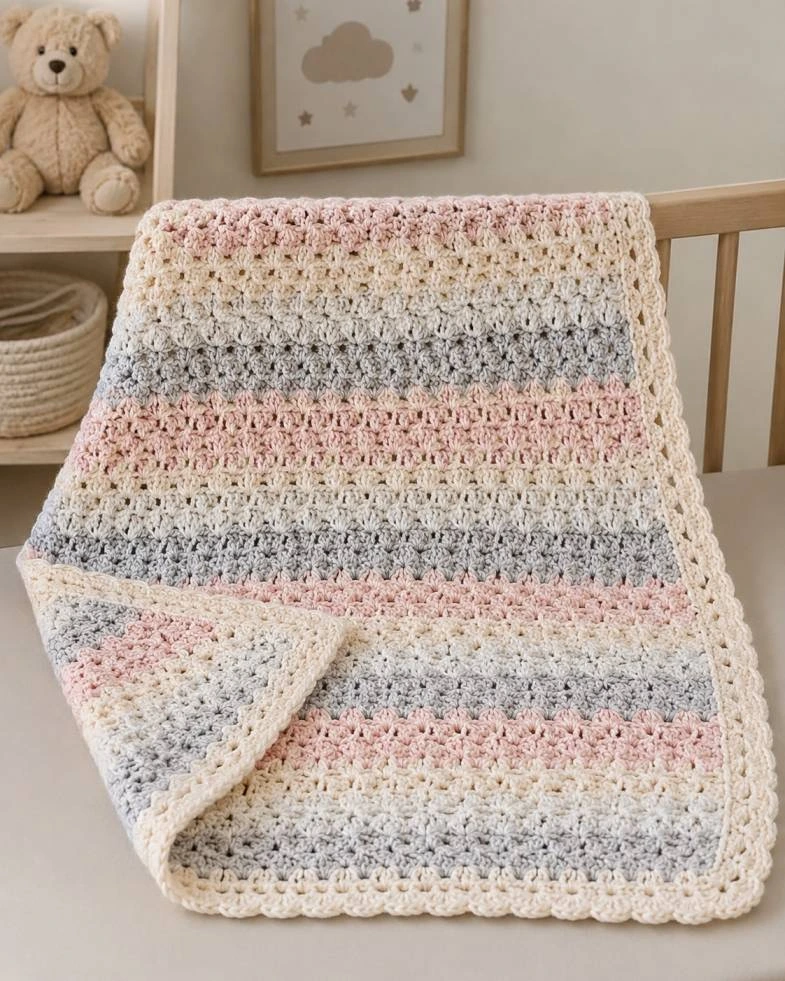
For the prettiest texture, many crocheters reach for stitches with visual interest, like the shell stitch, the V-stitch, basketweave, or a classic ripple (chevron) pattern. These add movement and texture without being difficult once you learn the repeat.
For safety, the priority shifts. A stitch pattern with large open gaps (think very lacy filet crochet or wide mesh patterns) isn’t ideal for a very young baby’s blanket, since small fingers and even toes can get caught in bigger holes. A tighter stitch like single crochet, half double crochet, or a solid granny square is generally considered a safer choice for newborns and infants who will be unsupervised with the blanket, such as in a crib.
If you’re choosing a single stitch to learn for your first crochet baby blanket, half double crochet is a solid middle ground: it works up faster than single crochet, has a soft, even drape, and keeps gaps small enough to be crib-appropriate.
Quick Project Overview
- Project type: Flat, rectangular crochet baby blanket
- Difficulty level: Beginner to easy-intermediate, depending on stitch choice
- Approximate finished size: Baby blankets commonly range from about 30 x 30 inches (a lovey or stroller size) up to 36 x 40 inches (a standard crib-adjacent size). Exact dimensions vary by pattern and personal preference.
- Estimated time: Anywhere from a few evenings to a few weeks, depending on stitch, yarn weight, and hook size
- Yarn weight: Typically DK (light worsted) or worsted weight (medium, category 4) for a soft, washable blanket
- Hook size: Commonly a 4.5 mm to 5.5 mm (US G/6 to I/9) hook, adjusted to match your yarn weight and desired drape
- Main techniques: Working in rows or rounds, basic increases/decreases (if shaped), color changes, edging
- Construction method: Most baby blankets are worked flat, row by row, though some are made as joined granny squares or motifs
These numbers are general guidelines rather than fixed rules — your gauge, hook, and yarn will shift the final size and timeline.
Materials and Tools
- Yarn: A soft, machine-washable yarn is essential for baby items. Acrylic, cotton, and acrylic-cotton blends are all popular because they hold up well to frequent washing. Avoid novelty yarns with loose fibers or fuzzy textures that could shed near a baby’s face.
- Yarn colors: Pastels, neutrals, and soft multicolor combinations are classic choices, but there’s no rule that says a baby blanket has to be pastel. Bold colors and stripes work beautifully too.
- Crochet hook: Choose a hook size recommended on your yarn label, then adjust half a size up or down to get the drape you want. A smaller hook makes a tighter, warmer fabric; a larger hook makes a softer, more open one.
- Yarn needle: For weaving in ends and seaming pieces together.
- Scissors
- Stitch marker: Helpful for tracking rows or the start of a round if working motifs.
- Measuring tape: To check your gauge swatch and track blanket size as you go.
- Blocking pins and mat (optional): Useful if you want crisp, even edges, especially with textured or motif-based patterns.
Crochet Abbreviations Used in This Guide
- ch — chain
- sc — single crochet
- hdc — half double crochet
- dc — double crochet
- sl st — slip stitch
- inc — increase
- dec — decrease
- rep — repeat
- sk — skip
- st(s) — stitch(es)
Gauge and Why It Matters
Gauge matters more for a baby blanket than you might expect, because it determines both the finished size and how much yarn you’ll need. A tight gauge (smaller hook, denser stitches) produces a warmer, sturdier fabric, which is nice for a blanket that will get washed often. A looser gauge drapes more softly but can also let a stitch pattern’s holes open up wider than intended.
Before starting a full-size blanket, crochet a swatch about 4 x 4 inches in your chosen stitch and yarn. Measure it, and if your stitch count doesn’t match your pattern’s gauge, adjust your hook size up or down until it does. If you’re designing your own blanket rather than following a set pattern, gauge still matters for figuring out roughly how wide your starting chain needs to be.
How Many Chains to Start a Crochet Baby Blanket
This is one of the most common questions for good reason: it depends entirely on your yarn, hook, and desired width, so there isn’t one universal number.
The reliable way to find your starting chain is:
- Crochet a gauge swatch and count how many stitches fit into 4 inches in your chosen stitch pattern.
- Divide that number by 4 to get your stitches-per-inch.
- Multiply your stitches-per-inch by the finished width you want (for example, 32 inches).
- Add the chain stitches your particular stitch pattern needs at the start of a row (single crochet typically needs 1 turning chain that isn’t counted as a stitch, half double crochet needs 2, and double crochet needs 3).
- Round to a multiple that matches your stitch pattern’s repeat if you’re using a patterned stitch like shells or a chevron, since those need the chain count to divide evenly into the repeat.
As a rough starting point, many worsted-weight baby blankets in single or half double crochet with a 5 mm hook fall somewhere around 100 to 130 chains for a 30–36 inch width, but always confirm this with your own gauge swatch rather than relying on someone else’s number, since tension varies a lot from crocheter to crocheter.
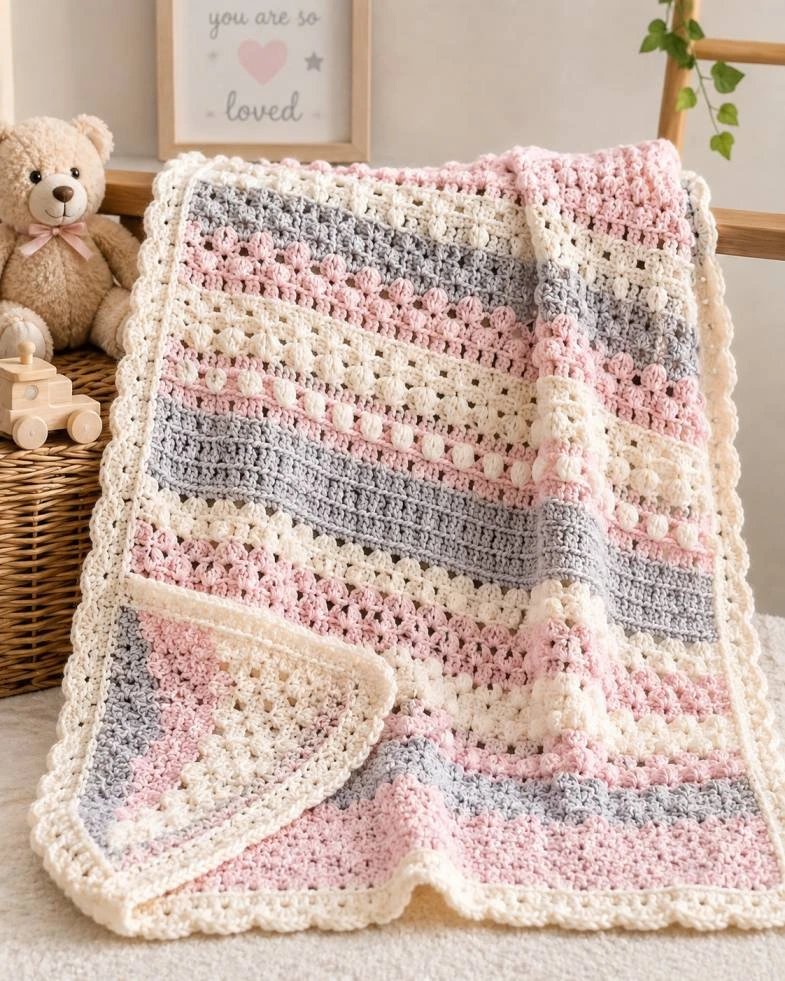
Crochet Baby Blanket Pattern Framework
Because stitch, yarn weight, hook size, and desired dimensions all change the exact instructions, what follows is a clear, adaptable framework rather than a single fixed pattern. You can plug in your own gauge and stitch choice.
Foundation Row
Chain the number of stitches determined by your gauge swatch (see the chaining section above), plus the appropriate turning chain for your stitch.
Body of the Blanket
Work your chosen stitch pattern in rows across the full width, turning at the end of each row with the correct turning chain (1 ch for sc, 2 ch for hdc, 3 ch for dc). Continue evenly, keeping your stitch count consistent row to row, until the blanket reaches your desired length. Measure periodically as you go rather than only at the end, so you can catch tension changes early.
If you’re using a stitch that increases and decreases in a repeat, like a ripple/chevron, follow the repeat’s increase and decrease points consistently on every row so the peaks and valleys stay aligned.
Color Changes (If Using Stripes)
To change colors cleanly, work the last stitch of the old color until two loops remain on the hook, then yarn over with the new color and pull it through both loops to finish the stitch. This way the new color is already in place at the start of the next stitch. Carry unused colors up the side if stripes are only a few rows apart, or cut and weave in ends if colors are used farther apart.
Border/Edging
Once the blanket reaches your target length, work a border to stabilize the edges and give the blanket a finished look. A simple, sturdy option is one or two rounds of single crochet worked evenly around all four sides, with 3 single crochets in each corner stitch to keep the corners from puckering or curling.
Fastening Off
Finish with a slip stitch into the first stitch of the final round, cut the yarn leaving a 6 inch tail, and pull it through the last loop to secure it.
Assembly and Finishing
- Weave in all yarn ends securely using a yarn needle, running the tail through several stitches on the wrong side and trimming any excess.
- Lightly block the blanket if the yarn fiber allows it (check your yarn label), which helps even out stitches and flatten curling edges.
- Do a final check for any missed ends, uneven stitches, or loose spots along the border.
- Fold and store, or wrap as a gift.
Stuffing and Shaping Tips (Not Applicable) / Keeping the Blanket Flat and Even
Baby blankets don’t use stuffing, but keeping the fabric flat and even matters just as much as shaping does for an amigurumi toy. A few things help:
- Keep consistent tension throughout, especially if you set the project down for a while between sessions; picking a slightly looser or tighter tension after a break is one of the most common causes of uneven blankets.
- Count your stitches at the end of every few rows, not just occasionally, so you catch a dropped or added stitch early instead of unraveling several rows later.
- Block the finished piece if your yarn fiber supports it, which relaxes the stitches and helps square up the edges.
- Avoid stretching the blanket while working; let the stitches sit at their natural size on the hook.
Common Mistakes and Troubleshooting
- Blanket edges curl or wave: Usually caused by uneven tension at the start/end of rows, or by a border that doesn’t have enough stitches at the corners. Add extra stitches in each corner during the border round.
- Blanket isn’t square: Often comes from inconsistent turning chains or accidentally adding/skipping a stitch. Count stitches every few rows to catch this early.
- Colors bleed or gaps show at color changes: Make sure the color switch happens on the last yarn-over of a stitch, not partway through, and keep tension even right at the join.
- Fabric feels too stiff: Try a larger hook or a looser-draping stitch like half double crochet or a shell pattern.
- Fabric feels too loose or holey: Try a smaller hook or switch to a denser stitch like single crochet.
- Blanket is a different size than planned: Re-check your gauge swatch measurement, since gauge shifts happen easily with a different yarn batch, hook brand, or even how relaxed you are while crocheting.
Customization Ideas
- Swap the color palette to match a nursery theme, gender-neutral tones, or the parents’ favorite colors.
- Make a smaller “lovey” or stroller-size version using the same stitch pattern with a shorter starting chain and fewer rows.
- Add a scalloped or picot edging for extra detail on the border.
- Personalize with a crocheted or embroidered initial appliqué.
- Work the blanket in wide stripes for a bold, modern look, or thin stripes for a subtler effect.
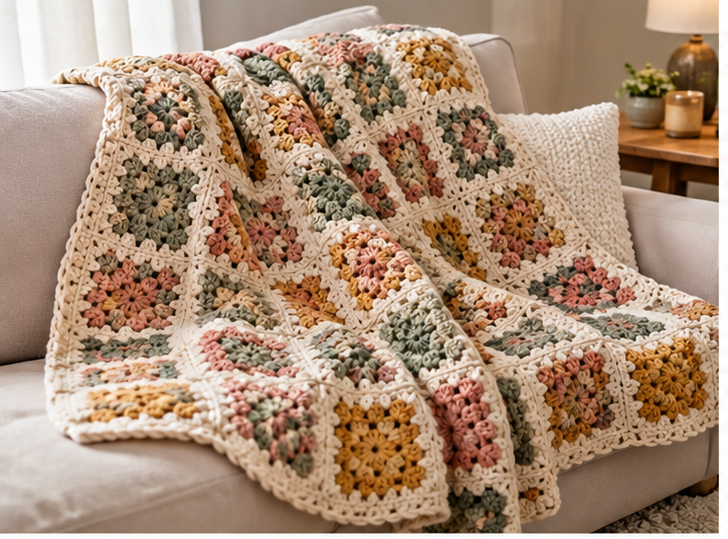
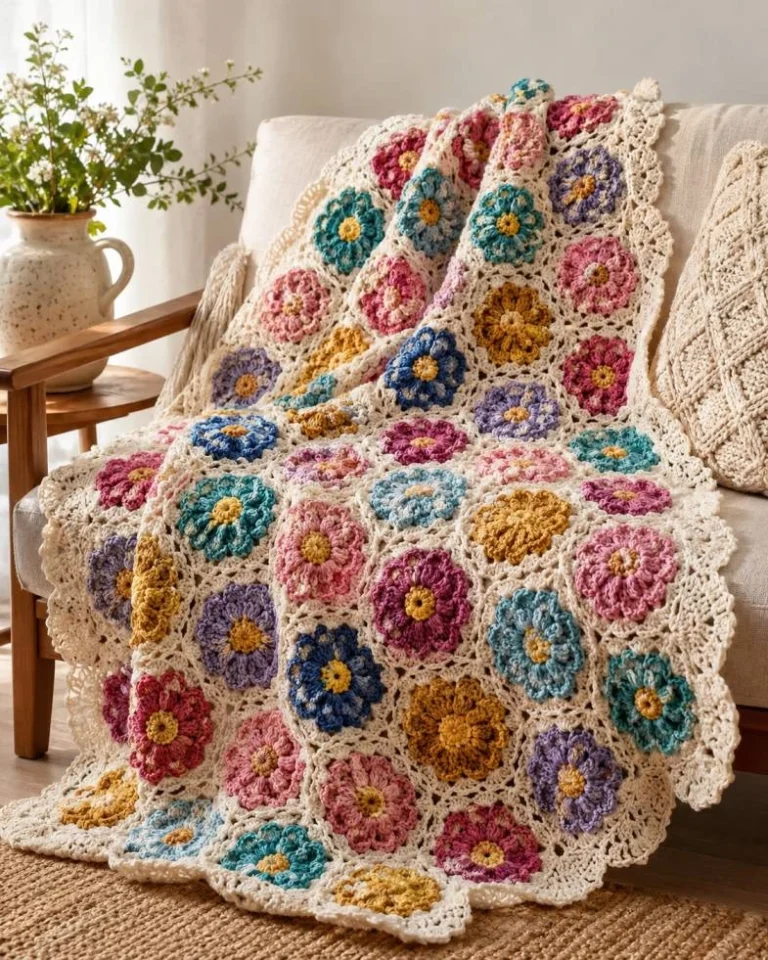
- Try a granny-square version by joining individual squares instead of working flat rows, which is a great option for using up scrap yarn.
Care Instructions
- Check the yarn label for exact washing guidance, since fiber content changes the care instructions.
- Most acrylic and acrylic-blend baby blankets can be machine washed on a gentle, cold cycle and tumble dried on low, though air drying flat helps the blanket keep its shape longer.
- Cotton blankets often do well hand washed or on a gentle cycle, then laid flat to dry to avoid stretching.
- Store folded in a clean, dry place, away from direct sunlight, to keep colors from fading over time.
Safety Note
For very young babies, choose a stitch pattern without large gaps, avoid anything with small attachable pieces like buttons or beads, and follow current safe sleep guidance, which generally recommends keeping loose blankets out of a crib during unsupervised sleep for infants. A crochet baby blanket is wonderful for tummy time, stroller rides, swaddling with supervision, or as a keepsake, but always check current pediatric safety guidance for how and when loose blankets are appropriate for your baby’s age.
FAQ
What is the best crochet stitch for making a baby blanket? There isn’t one single “best” stitch, it depends on your goal. Single crochet and half double crochet are dense, even, and beginner-friendly. Double crochet and shell stitches work up faster. For a balance of ease, speed, and a soft finish, half double crochet is a favorite among crocheters making their first baby blanket.
What is the easiest baby blanket crochet pattern? A simple single crochet or half double crochet blanket worked straight in rows, with or without stripes, is generally considered the easiest place to start. It only requires knowing how to chain, work the stitch, and turn at the end of each row.
What is the fastest crochet stitch for a baby blanket? Taller stitches like double crochet, or a chunky yarn paired with a larger hook, will finish faster than shorter stitches like single crochet, simply because each row covers more height in fewer passes.
What is the safest crochet stitch for baby blankets? Tighter stitches with small, even gaps, such as single crochet, half double crochet, or a solid granny square, are considered safer than open, lacy stitch patterns, since they reduce the risk of small fingers or toes catching in larger holes.
How many chains should I do for a crochet baby blanket? It depends on your gauge, hook, and yarn. Crochet a gauge swatch, calculate your stitches per inch, then multiply that by your desired blanket width and add the appropriate turning chain for your stitch. There’s no single universal chain count that works for every yarn and hook combination.
What is the prettiest crochet stitch for a baby blanket? This comes down to personal taste, but textured stitches like the shell stitch, V-stitch, basketweave, and ripple/chevron patterns are frequently chosen for their visual interest and are still manageable once you learn the repeat.
Is there an old wives’ tale about baby blankets? Baby blankets carry a lot of folklore across different cultures, from beliefs about certain colors or patterns bringing good luck to superstitions about not finishing a baby item before the baby arrives. These stories vary widely by region and family tradition rather than having one single universal version.
Why do adults still sleep with baby blankets? Many adults keep a childhood blanket as a comfort object tied to nostalgia and familiar sensory texture, and this attachment can simply continue naturally into adulthood for some people. It’s a common and normal habit rather than something unusual.
Why do hospitals often use similar striped blankets for newborns? Many hospitals use a recognizable style of receiving blanket, often with pink and blue stripes, largely because it’s a practical, easily identifiable, and cost-effective standard supply choice, not because of any special crochet or care requirement. A handmade crochet version can absolutely be used at home instead once you’re past the hospital stay.
How do I make my crochet baby blanket bigger or smaller? Add or subtract chains at the start in multiples that match your stitch pattern’s repeat, then add or remove rows to adjust the length. Recheck your gauge swatch if you change yarn weight or hook size, since that shifts your calculations.
Final Thoughts
A crochet baby blanket is a project that rewards patience without demanding advanced skills. Pick a stitch that matches your comfort level and timeline, keep your tension consistent, and don’t be afraid to swatch before diving into the full project. Whatever stitch or color combination you land on, a handmade crochet baby blanket ends up being something a family keeps for years, not just something a baby outgrows.