The Easiest Crochet Blanket Pattern: A Cozy Granny Stripe Throw
There’s a specific kind of yarn-shop guilt that comes from buying a gorgeous skein, taking it home, and then never touching it again because the pattern you picked out turned out to be way more than you bargained for. I’ve done it more than once. A “quick weekend blanket” that ate three weekends. A stitch pattern that looked simple in the photo and turned into a headache of miscounted rows by hour two.
So when people ask what the easiest crochet pattern for a blanket actually is, I don’t send them toward anything fancy. I send them toward the granny stripe. It’s forgiving, it’s fast, and it’s the closest thing crochet has to a stitch that hides its own mistakes. If you’ve been wondering about the best crochet stitch to make a blanket, or what you could realistically finish in a few evenings, this is the project — and the full pattern is below.
Quick Project Overview
- Difficulty: Beginner-friendly
- Finished size: Approximately 32 x 40 inches (easy to size up or down)
- Yarn weight: Worsted weight (#4)
- Hook size: 5.5mm (US I-9)
- Technique: Shell/granny stripe stitch, worked flat in turned rows
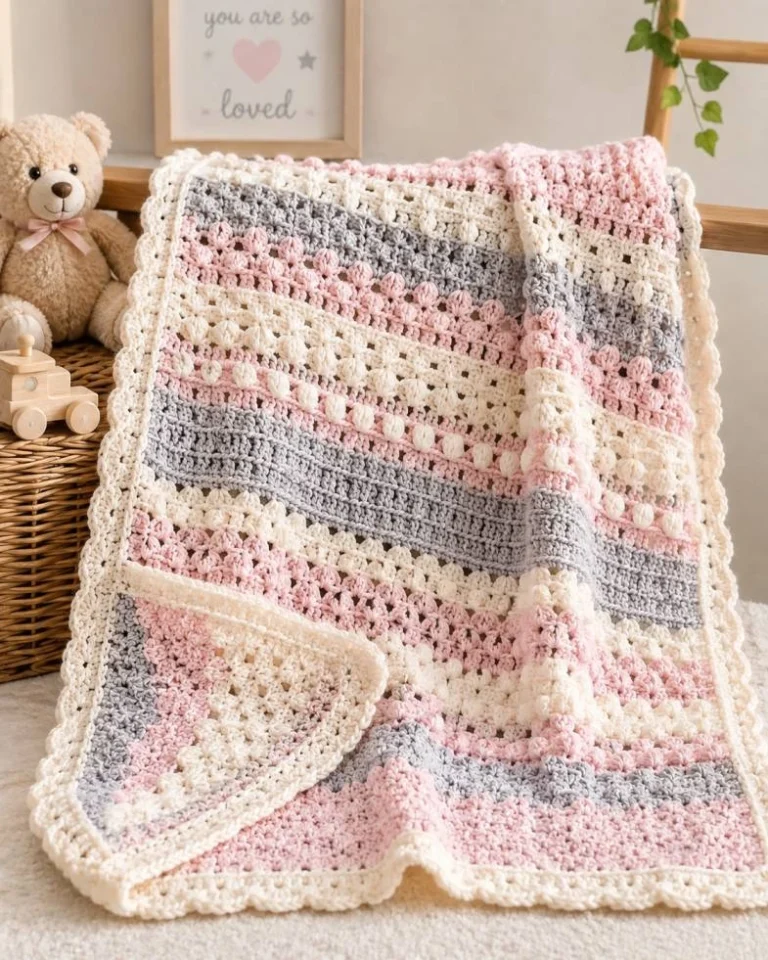
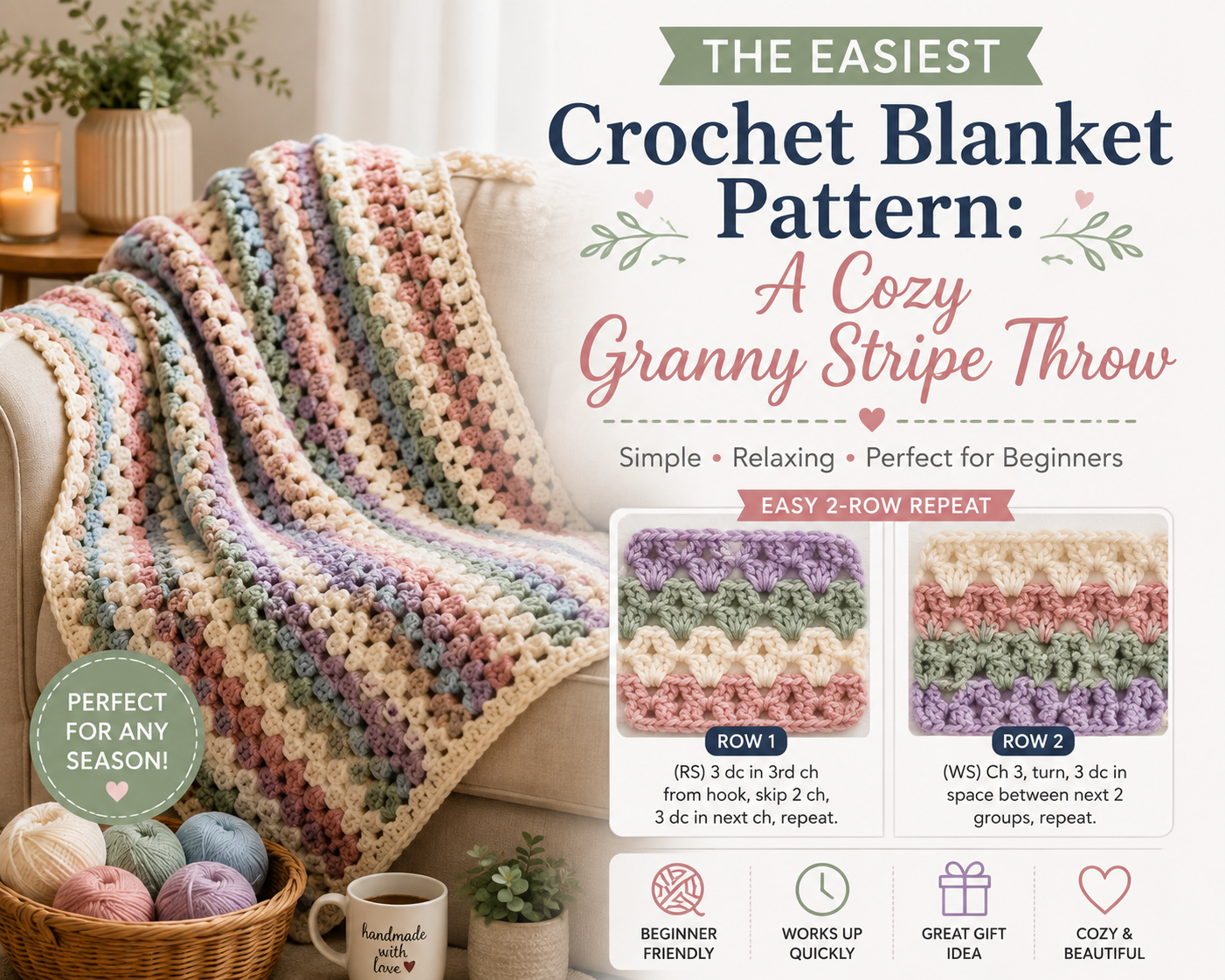
Worked in two or three colors, this reads as clean, modern stripes — the shell texture adds dimension without adding real difficulty.
Materials and Tools
- Yarn: Worsted weight (#4) in 2–3 colors, roughly 600–700 yards total. A soft acrylic or acrylic-cotton blend holds up well to regular washing.
- Hook: 5.5mm (US I-9) — go up or down half a size if your stitches feel too tight or loose.
- Yarn needle, scissors, and optional stitch markers
Abbreviations
ch (chain), dc (double crochet), sk (skip), sl st (slip stitch), RS/WS (right side/wrong side), MC/CC (main/contrast color)
Gauge
Not critical here — a slightly bigger or smaller blanket is still a great blanket. As a reference, three shells and four rows measure about 4 x 4 inches with this yarn and hook. Adjust hook size if you want a more exact finished measurement.
The Pattern:
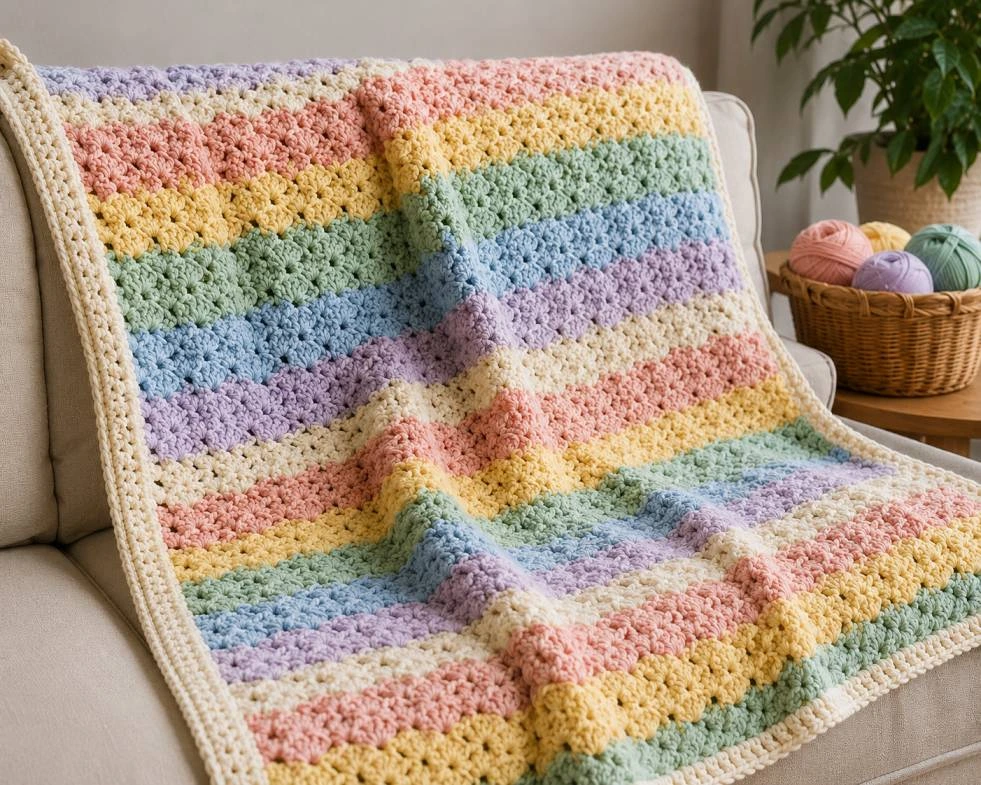
Foundation Chain
With your main color, chain 92 — a multiple of 3, plus 2 extra stitches for the edges, giving 30 shells across.
To resize: add or subtract chains in multiples of 3. Chain 83 for a baby-blanket width (27 shells), or chain 122 for a full-size throw (40 shells).
Row 1 (RS)
Dc in the 3rd chain from the hook, dc in the next chain. *Sk 2 ch, work 3 dc in the next chain (your first shell); repeat from * across, ending sk 2 ch, dc in the last chain. Turn.
Count check: 30 shells, with a single dc bookending each side.
Row 2 and Onward
Ch 2 (doesn’t count as a stitch), turn. Work 2 dc into the first stitch. *Sk the next 2 stitches, work 3 dc into the center stitch of the next shell below; repeat from * across, ending sk 2 stitches, dc into the last stitch. Turn.
Count check: every row should return to 30 shells. If it doesn’t, recheck how many stitches you’re skipping at the start and end of the row.
Repeat Row 2 until the Blanket measures about 40 inches, ending after a WS row so you finish on a clean RS edge.
Changing Colors
Work two full rows per color before switching. Change on the last yarn over of the final stitch in the old color, then chain 2 in the new color to start the next row — this keeps the color break tucked neatly into the row rather than left as a visible knot.
Border
Work one to two rounds of single crochet evenly around all sides, placing 3 sc in each corner stitch to keep corners from puckering. Join with a sl st to close.
Color-Change and Troubleshooting Tips
- Always switch color on the last yarn over of a stitch, never mid-row.
- Leave 6-inch tails and weave ends in along the side edge, not across the front.
- Shell count drifting: usually caused by skipping the wrong number of stitches near an edge — recount the first and last shell of the row.
- Wavy edges: means too many stitches are landing in the edge stitch. Stick to 2 dc at the start, 1 dc at the end of each row.
Customization Ideas
- Two-color version: alternate one main color with a single accent for a cleaner look.
- Ombré: use a gradient or self-striping yarn instead of switching skeins by hand.
- Baby blanket: chain 83, stop around 30 inches long.
- Full-size throw: chain 122, continue to 60 inches long.
Care Instructions
Check your yarn label, but most acrylic blends can be machine washed on gentle/cold and laid flat to dry so the shells don’t stretch out of shape. Press out excess water rather than wringing, and reshape while damp.
Frequently Asked Questions:
What is the easiest crochet pattern for a blanket?
The granny stripe is one of the easiest options because it’s built from a single repeated shell stitch worked the same way on every row — very little counting compared to patterns with multiple stitch types, and small mistakes blend into the texture instead of standing out.
Which crochet stitch makes a blanket the fastest?
Shell stitches like this one work up quickly because you’re placing three stitches into one spot rather than working across a row one stitch at a time. Basic double crochet is also fast, but shells cover more ground per stitch made.
Can I make this blanket a different size?
Yes — the foundation chain is based on a multiple of 3, so you can add or subtract chains in groups of three to change the width, and stop rows earlier or later to control the length.
Do I need to worry about gauge for a blanket?
Not the way you would for clothing. Gauge here mainly affects final dimensions, so if an exact size matters, check your shell measurements against the reference gauge and adjust your hook if needed.
Final Thoughts
A blanket doesn’t need to be complicated to be worth making. This granny stripe pattern is about as close as crochet gets to instant gratification — a simple, repeatable stitch that turns into visible progress fast, and forgives the small wobbles that come with learning. Grab two or three colors you love, and let the stripes do the rest.