How to Cook Barley Perfectly: A Chef’s No-Fail Guide for Beginners
Everything I wish someone had told me the first time I dumped a pot of barley into boiling water and hoped for the best.
I still remember my first real encounter with barley. I was working the soup station on a slow Tuesday, and the chef tossed me a bag of pearl barley and said, “Get this into the mushroom soup by four.” No instructions. No ratios. Just a bag of little pale grains and a deadline. I rinsed it half-heartedly, tossed it in, and thirty minutes later, we had a soup that was more paste than broth. Lesson learned the hard way: barley rewards patience, and it punishes shortcuts.
If you’ve ever stood in your kitchen staring at a bag of barley wondering whether to soak it, rinse it, or just wing it — you’re in good company. It’s one of the most under-explained grains out there, which is a shame, because once you understand its rhythm, it’s genuinely one of the easiest things you’ll ever cook.
Quick Takeaways
- Pearl barley doesn’t need soaking — it cooks in 30–40 minutes straight from the bag.
- Rinsing removes surface starch and grit, and it’s a step worth doing every time.
- Barley beats white rice on fiber and can support satiety and weight management, but it’s not gluten-free.
- The 3:1 water-to-barley ratio and a gentle simmer are all you really need to remember.
- Cooked barley keeps 3–4 days in the fridge, or up to two months frozen.
Is Barley Actually Healthier Than Rice?
This is the question I get asked most, usually by someone trying to eat a little cleaner without giving up their grain bowls. Here’s the honest answer: it depends what you’re optimizing for.
Gram for gram, barley has significantly more fiber than both white and brown rice — we’re talking roughly three to four times the fiber content. That fiber is exactly why barley tends to keep you full longer, which is the whole mechanism behind its reputation as a weight-loss-friendly grain. It slows digestion, blunts the blood sugar spike you’d get from a plain bowl of white rice, and just sits with you longer. There’s even emerging research showing that swapping refined grains for barley can modestly reduce body weight, waist circumference, and LDL cholesterol over a matter of weeks.
Rice isn’t the villain here, though. White rice has a gentler, more neutral flavor, it’s naturally gluten-free, and enriched rice actually delivers more folate and B vitamins than barley does. So if you’re managing celiac disease or gluten sensitivity, barley is off the table entirely — it’s a true gluten-containing grain, not just cross-contaminated. For everyone else, I tell people to think of barley less as a replacement for rice and more as a rotation. Use it where its chew and nuttiness shine: soups, stews, grain salads, pilafs.
Should You Soak Barley Before Cooking?
Here’s where a lot of confusion creeps in, because “barley” isn’t one single ingredient — it’s a family. And the soaking rules change depending on which member of the family is sitting in your pantry.
Pearl barley (the one most home cooks buy)
Pearl barley has already been milled to remove the tough outer bran layer, which is exactly the part that benefits most from soaking. That means soaking is optional, not essential. Skip it, and you’ll still have tender barley in 30 to 40 minutes. Soak it for an hour or two, and you might shave five to ten minutes off that cooking time — a nice-to-have, not a game-changer.
Hulled barley (the whole-grain version)
This is the one that actually rewards soaking. Because the bran and germ are still intact, hulled barley is tougher and takes 45 minutes to over an hour to cook. Soaking it for several hours, or overnight, softens the grain, cuts your cooking time noticeably, and — for what it’s worth — makes it easier to digest.
My rule of thumb: if you forgot to soak and dinner’s in an hour, grab pearl barley and don’t stress. If you’re planning ahead and want maximum nutrition and a shorter cooking window, soak the hulled version overnight.
How to Cook Barley Perfectly: A Chef’s No-Fail Method
Ingredients
Notes
- Rinse the barley under cold water before cooking.
- Use 3 cups of water or broth for 1 cup of pearl barley.
- Simmer gently until the barley is tender but still slightly chewy.
- Drain any excess liquid after cooking.
- Let the barley rest for 5 minutes before serving.
- Store leftovers in an airtight container in the refrigerator for up to 5 days.
The Step-by-Step Recipe: Foolproof Stovetop Barley
This is the exact method I use when I want barley that’s tender, never mushy, and ready to go into anything from a soup to a salad.
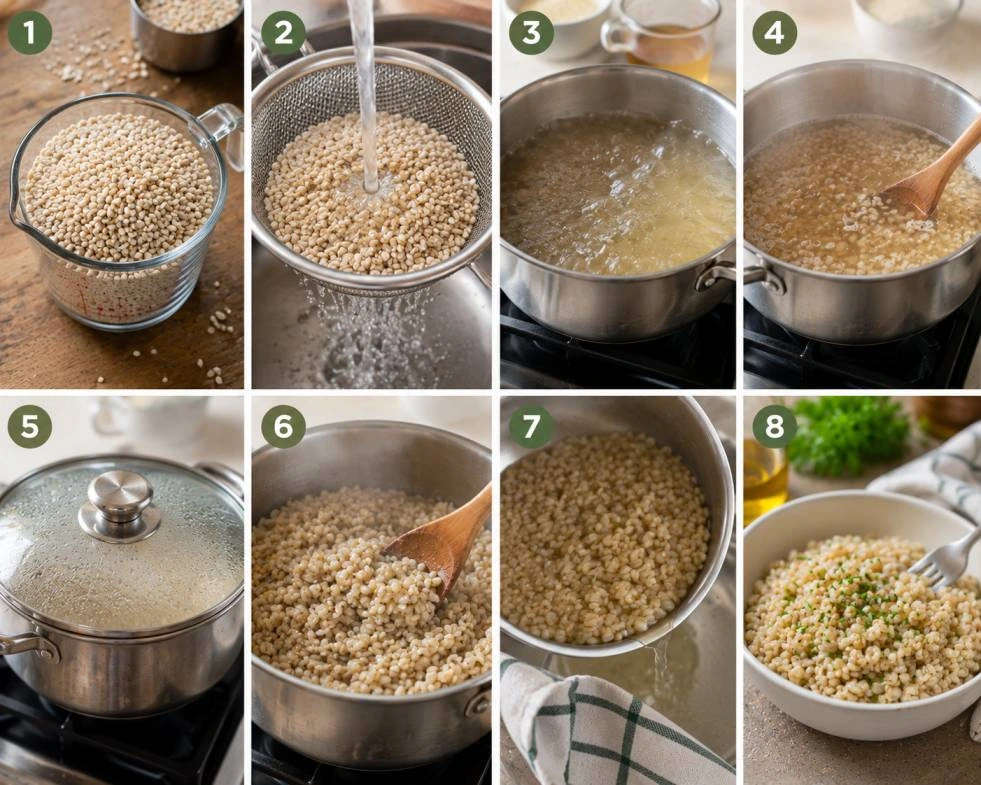
- Measure your grain. One cup of dry pearl barley will triple in volume, giving you roughly three cups cooked — plenty for a side dish for four.
- Rinse it. Tip the barley into a fine-mesh sieve and rinse under cold running water until it runs clear, about 30 seconds. This washes away surface starch and any dust from packaging.
- Bring your liquid to a boil. Use a 3:1 ratio — three cups of water or stock for every cup of barley. Stock adds noticeably more flavor if you’re serving it on its own.
- Add the barley and salt. Once the liquid is at a rolling boil, stir in the barley and a good pinch of salt.
- Drop to a simmer and cover. Barley tends to foam up right as it hits a boil, so watch it for the first minute, then reduce the heat to low and cover the pot.
- Cook 30–40 minutes. Give it a stir occasionally so nothing sticks to the bottom. You’re looking for grains that are tender with just a little chew left — think al dente pasta, not baby food.
- Drain any excess liquid, then rest. If there’s leftover water, drain it off. Let the barley sit covered for five minutes off the heat — this lets the steam finish the job evenly.
- Fluff and serve. A fork through the grains right before serving keeps everything light instead of clumped.
How Long Should You Actually Boil Barley?
The honest answer is a range, not a fixed number, because it depends on the type of barley and how much bite you like. Pearl barley is generally done at the 30-minute mark, though I always start checking around 25 minutes — nothing worse than overshooting and ending up with mush. Hulled barley needs closer to 40 minutes to an hour, since it’s carrying more of its original fiber-rich structure.
The real test isn’t the clock, though — it’s your teeth. Fish out a grain and bite into it. If it’s tender all the way through with just a whisper of chew at the center, it’s done. If the middle still feels hard and starchy, give it another five minutes and check again.
One more thing worth knowing, especially if barley water has come up in your research: boiling barley in a larger volume of water and then straining off the liquid is exactly how barley water is made. That strained liquid is genuinely nutritious — rich in soluble fiber, antioxidants, and minerals like magnesium and manganese — but it does still contain gluten, and most people should keep it to one or two glasses a day rather than treating it as a cure-all.
What Happens If You Don’t Rinse Pearl Barley?
Short version: nothing catastrophic, but nothing great either. Skipping the rinse leaves surface starch on the grains, and that starch is what makes barley go gluey and clump together as it cooks — the exact texture you don’t want if you’re serving it as a light, fluffy side. If it’s headed straight into a thick soup or stew, a little extra starch barely matters since it’ll just help thicken the pot slightly. But for a standalone pilaf or grain bowl, that 30-second rinse under cold water is the difference between distinct, separate grains and a sticky clump. It also washes away any dust or debris left over from processing — a basic hygiene step I’d never skip regardless of the dish.
Storing and Reheating Leftover Barley
Cooked barley is one of the better make-ahead grains in your arsenal. Cooled and stored in an airtight container, it holds up in the fridge for three to four days, and it freezes beautifully for up to two months — portion it out flat in freezer bags so you can break off exactly what you need. Reheat with a splash of water or broth to bring back some moisture, either on the stovetop or in the microwave.
Frequently Asked Questions
Is barley better than rice for weight loss?
Barley generally has the edge for weight management because of its higher fiber content, which promotes fullness and slows digestion more than rice does. That said, rice isn’t a poor choice either — it’s the better option if you need something gluten-free, and pairing it with a balanced, calorie-conscious meal can support weight loss just as effectively.
Should I soak barley before cooking it?
It depends on the type. Pearl barley doesn’t require soaking — it cooks fine in 30–40 minutes straight from the package. Hulled barley, which still has its bran intact, benefits from a soak of several hours or overnight, since it shortens the cooking time and softens the tougher grain.
How long should you boil barley?
Pearl barley typically needs 30–40 minutes at a gentle simmer, while hulled barley needs closer to 45–60 minutes. The clock is a guideline — the real test is biting into a grain to check it’s tender with just a slight chew in the center.
What happens if you don’t rinse pearl barley?
Skipping the rinse won’t ruin the dish, but it leaves surface starch on the grains, which can make the barley clump and turn gummy rather than staying light and separate. It also leaves behind any dust from processing. A quick 30-second rinse under cold water solves both issues.
Barley isn’t a difficult ingredient — it’s just a misunderstood one. Once you know that pearl barley doesn’t need babysitting, that a rinse is worth the thirty seconds, and that “done” is a matter of taste-testing rather than clock-watching, you’ll find yourself reaching for it far more often. It’s the kind of grain that turns a thin soup into something hearty, and a plain side dish into something with actual texture and character.
Try it this week: cook a batch using the method above, then toss it warm with olive oil, lemon, feta, and whatever herbs you have on hand. Once you taste what properly cooked barley is supposed to be like, you won’t go back to guessing.
Made a batch? I’d genuinely love to know how it turned out.
Drop a comment below with your barley win (or your barley disaster — we’ve all had one) and let’s swap notes.