The Amaretto Sour: A Beginner’s Guide to Nailing This Deceptively Simple Cocktail
Amaretto
I still remember the first Amaretto Sour I ever made behind a bar. I was maybe three weeks into the job, a regular ordered one like it was the easiest thing in the world, and I froze. Two ingredients? Three? Egg white or no egg white? I improvised, handed it over, and watched him take one sip and nod slowly — the universal bartender sign for “you didn’t ruin it.” That drink has humbled more rookie bartenders than almost anything else on a classic cocktail menu, precisely because it looks so simple on paper.
That’s really the whole story of the Amaretto Sour: a drink that looks like it should take thirty seconds to make, and does, once you actually understand what it’s doing. This guide walks you through exactly that — the ingredients, the two schools of thought on how to build it, a step-by-step recipe you can follow tonight, and answers to the questions people ask most.
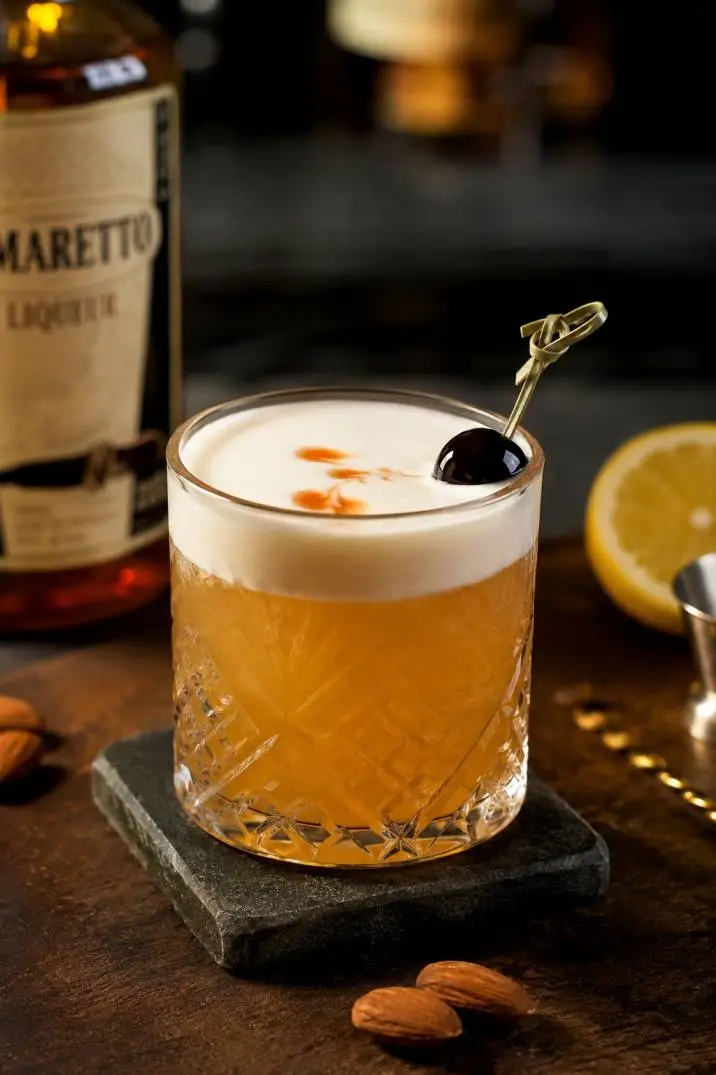
Classic Amaretto Sour Cocktail (Easy Beginner Recipe)
Method
- 2 oz amaretto (Disaronno is the standard choice)
- ¾ oz fresh lemon juice (not bottled — it makes a real difference)
- ½ oz simple syrup
- 1 egg white (optional, but it’s what gives you that silky foam on top)
- 2–3 dashes Angostura bitters (for the garnish on top of the foam)
- Brandied cherry + orange twist (for garnish)
How to Make an Amaretto Sour, Step by Step
This is the version I’d make for you if you walked up to my bar tonight. It uses fresh ingredients and includes the egg white, because once you taste the difference in texture, you won’t want to go back.
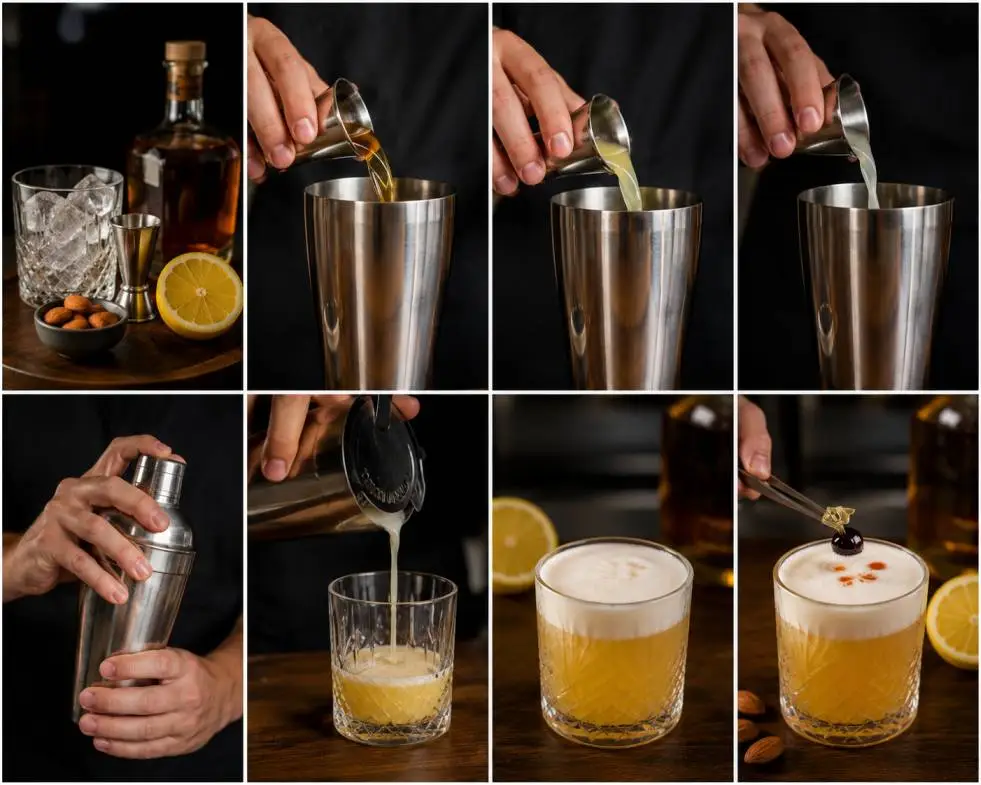
Gather your tools.
You’ll need a cocktail shaker, a jigger or measuring tool, a fine-mesh strainer, and a rocks glass.
Measure your ingredients.
Into the shaker (without ice yet), add 2 oz amaretto (Disaronno works beautifully), 3/4 oz fresh lemon juice, 1/2 oz simple syrup, and 1 egg white.
Dry shake first.
Seal the shaker and shake hard for about 15 seconds with no ice. This “dry shake” is what whips the egg white into a foam — skip this step and your foam won’t form properly.
Add ice and shake again.
Fill the shaker with ice, seal it, and shake vigorously for another 15-20 seconds until the outside feels ice-cold.
Strain into your glass.
Use a fine-mesh strainer over a rocks glass filled with fresh ice — this catches any small ice shards and keeps the texture smooth.
Add the finishing touch.
Let the foam settle for a few seconds, then drop 2-3 dashes of Angostura bitters directly onto the foam. Drag a toothpick through them for a simple design if you’re feeling fancy.
Garnish and serve.
A brandied cherry and an orange twist are the classic finish. Serve immediately, while that foam is still perfect.
What Exactly Is an Amaretto Sour?
At its core, an Amaretto Sour belongs to the “sour” family of cocktails — the same family as a Whiskey Sour or a Pisco Sour. That family follows one basic formula: a base spirit, something sour (usually lemon juice), and something sweet to balance it out. In this case, the base spirit isn’t a spirit at all in the traditional sense — it’s amaretto, an Italian liqueur made from apricot pits or almonds, sometimes both, steeped and sweetened until it tastes like marzipan in liquid form.
That almond-forward sweetness is exactly why the drink needs a sharp, honest squeeze of lemon juice to keep it from tasting like dessert in a glass. Get the ratio right, and you end up with something that’s nutty, bright, a little boozy, and genuinely refreshing.
The Ingredients You’ll Actually Need
Here’s where a lot of home bartenders get tripped up, because you’ll find two very different “correct” versions of this drink depending on who’s pouring it.
- Amaretto — the star of the show. Disaronno is the most famous bottle on the market, and for good reason: it’s been the industry standard since 1525 (yes, really). Using Disaronno instead of a generic “amaretto” isn’t cheating — Disaronno essentially is the benchmark for what amaretto should taste like.
- Fresh lemon juice — never the bottled stuff. Fresh juice is the difference between a sour that tastes alive and one that tastes like cough syrup.
- Simple syrup — optional, and only needed if your amaretto isn’t sweet enough on its own or your lemon is particularly tart.
- Egg white — optional, but this is the ingredient that separates a good Amaretto Sour from a bar-quality one. It doesn’t add flavor so much as texture: a silky, almost meringue-like foam on top.
- Angostura bitters and a cherry — for garnish, and honestly, for good looks.
Two Ingredients, Three Ingredients — Which One Is “Right”?
Both. This is genuinely one of those rare cases where two different traditions both have a legitimate claim.
The two-ingredient version is the old-school, dive-bar classic: amaretto and sour mix (a pre-made blend of lemon juice, sugar, and sometimes egg white substitute), shaken and poured over ice. It’s fast, forgiving, and it’s what most people picture when they hear “Amaretto Sour.” Nothing wrong with it — it’s a legitimate and beloved drink in its own right.
The three-ingredient (or more) version is the craft-cocktail rebuild: amaretto, fresh lemon juice, and simple syrup, sometimes with egg white and bitters added. This is the version you’ll find at a serious cocktail bar, and it’s the one I’d recommend learning first, because it teaches you to actually taste and adjust rather than just pouring from a bottle labeled “sour mix.”
What You’ll Actually Get at a Bar
If you order this at a bar rather than making it yourself, you’re most likely getting some version of the three-ingredient build, minus the egg white unless it’s a cocktail-focused spot — egg whites take extra time and most high-volume bars skip them during a rush. As for strength: amaretto typically sits around 24-28% ABV (48-56 proof), noticeably lower than a straight pour of vodka or whiskey at 40%. That means an Amaretto Sour, diluted further by ice, juice, and shaking, usually lands somewhere around 10-15% ABV in the finished glass — comparable to a glass of wine, not a shot. It’s a drink you can sip through, not one that sneaks up on you after one glass, though two or three certainly will.
Frequently Asked Questions
What is the secret to a perfect Amaretto Sour?
Fresh lemon juice and a proper dry shake. Bottled sour mix and skipping the egg-white shake are the two most common reasons a homemade version falls flat compared to a bar-made one. Balance matters more than any fancy garnish — taste as you go and adjust the lemon-to-sweetness ratio until it’s bright, not cloying.
Is Taylor Swift’s favorite cocktail actually the Amaretto Sour?
No — this is a common mix-up in search results, but it isn’t accurate. Reports have said her favorite cocktail is the French Blonde, ordered during a night out in Kansas City in December 2023, and before that she’d named a Vodka Diet Coke as her go-to drink in a 2016 interview. There’s no verified reporting tying her specifically to an Amaretto Sour.
Will an Amaretto Sour actually get you drunk?
It can, like any cocktail, but it’s on the gentler end of the spectrum. Because amaretto’s ABV is lower than most base spirits and the drink is diluted with juice and ice, you’re looking at something closer to wine strength per glass. A couple of these over an evening will absolutely have an effect, but it’s not the kind of drink that catches people off guard the way a Long Island Iced Tea might.
Can you use Disaronno instead of amaretto?
Yes, without hesitation. Disaronno isn’t a substitute for amaretto — it’s simply the most recognizable, widely available brand of amaretto on the market, so much so that many people use the names interchangeably. Any recipe calling for “amaretto” is calling for exactly the style of liqueur Disaronno produces.